

2/2/2026
The role of music in elderly neural recruitment, second-language acquisition of children, and the reduction of symptoms regarding psychological issues of adults
It has long been discussed and inquired whether music can facilitate healing. Tracing back, we learn that even ancient civilizations, such as China, India, and Egypt, were using it as a means for therapeutic purposes. (Yıldırım, 2021) Colloquially rephrased as “nutrition of soul”, music found a place in Ottoman medical centers, alongside the sound of water, for the treatment of patients -especially for those who needed mental healthcare. Professionals who worked in the field even appointed “makams”(different modes in Turkish classical music) to attend to specific illnesses and conditions. (Karahan, 2006) With such remarkable historical and universal utilization, music remains an attention-grabbing topic in psychology that paves the way for further contemporary research. What we have discovered up to this point: Music can have various positive effects in many phases of an individual's life.
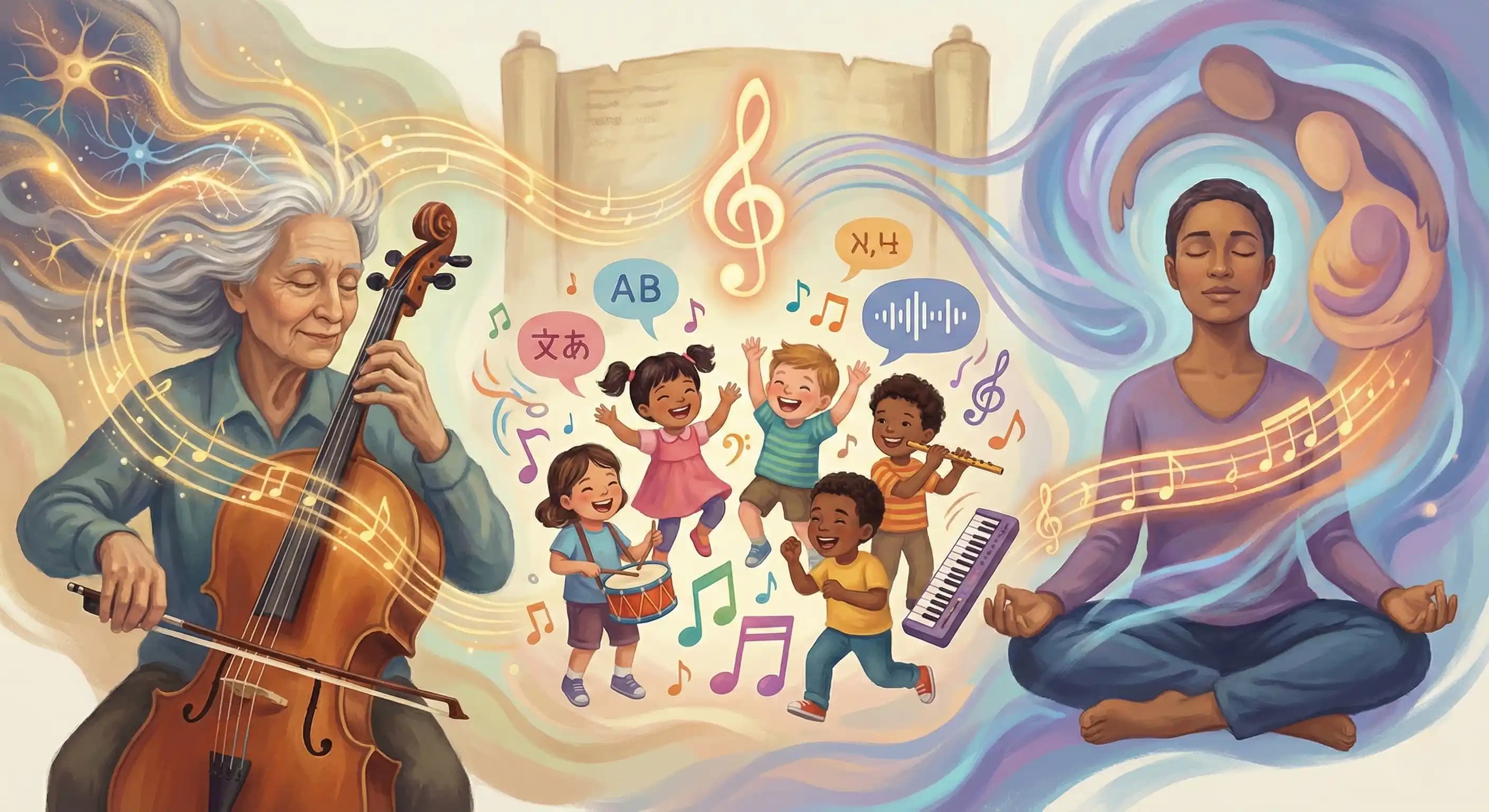
1- Music engagement supports neuroplasticity and helps maintain grey matter volume in old age
For elders, making music a part of their lives corresponds to slowing down the age-related cognitive decline. Not only music-making but also listening to musical pieces was found to activate neural connections that can give way to neuroplastic changes. (Chatterjee & Hegde, 2021) If you have already been in touch with music for a long period of time, it could become an even bigger advantage. According to Zhang and colleagues, in their elder years, musicians showed spatial functions that resemble those of youth, whereas those from other professions used more resources to do the same task that musicians did. (Zhang et al., 2025) Though it was demonstrated that any ongoing engagement in music making recruits the elderly brain, especially through enhancing grey matter volume. (McCary et al., 2022) These cognitive strengths can naturally allow an individual to lead an easier and more hopeful life in the late stages.
2- The relationship between music and the linguistic skills of children
When it comes to children, music appears to be beneficial for the language learning process. When they are having a hard time learning their native tongue, integration of music during preschool years comes to their aid. The result of a study with a group of 5-6-year-olds illuminated that their previous scores on linguistic tasks increased after attending a school where the activities are centered on music. (Toader, 2023) Even the acquisition of a second language can be more efficient thanks to musical activities. Parallel to the idea that various sounds in music contribute to mimicking the sounds of a foreign language that is distinct from a child’s native language, the initial processes of second-language acquisition were found to be more accurate and efficient in children who are musically more active. (Thompson et al., 2025) We can infer that, with all those skills improved through music, a child can grow up with better tools and self-confidence.
3- Music in the life of an adult with psychological struggles
In the phase of adulthood, the therapeutic aspect of music steps forward. When used as a therapy technique, it alleviates the symptoms of depression and helps individuals to have a better quality of sleep and life in general. (Youn et al., 2025) Apart from depression, music therapy can be significant for coping with anxiety. A study with university students illustrated that, as a therapy technique, music makes way for a decrease in anxiety symptoms, highlighting a particular efficiency in long-term implementations. (Li et al., 2025) Therefore, music can be claimed as a meaningful element for an adult who is coping with life struggles.
In short, all the aforementioned findings support the idea that music can be a vehicle for psychological improvement via its positive effects in cognitive, linguistic, and non-pharmacological intervention areas. Be it making music, having music therapy, or just listening to it, an individual’s well-being can be elevated through numerous striking ways of music.
References:
- Chatterjee, D., & Hegde, S. (2021). Neural plasticity: The substratum of music-based interventions in neurorehabilitation. [Frontiers in Psychology, 12.] ( https://doi.org/10.3389/fpsyg.2021.751636)
- Karahan, S. (2006). Tarihsel süreç içerisinde Türklerde müzikle terapi “Master's thesis, Istanbul University.” [Istanbul University Thesis Repository.] (https://nek.istanbul.edu.tr/ekos/TEZ/42099.pdf)
- Lee, Y. J., Kim, S. J., Yoon, J., & Lee, J. H. (2025). Music therapy for patients with depression: Systematic review and meta-analysis of randomised controlled trials. [BJPsych Open, 11.] (https://doi.org/10.1192/bjo.2025.10822)
- Li, S., Gong, Z., Wang, R., Liu, J., Zhan, X., Lan, J., & Feng, H. (2025). The efficacy of music therapy in alleviating anxiety among college students: A systematic review and meta-analysis. Frontiers.
- McCrary, J. M., Altenmüller, E., Kretschmer, C., Scholz, D. S., & et al. (2022). Association of music interventions with health-related quality of life: A systematic review and meta-analysis. JAMA Network Open, 5(3), e223236.
- Thompson, R. M., Salig, L. K., & Slevc, L. R. (2025). Is musical ability related to second-language acquisition? A meta-analysis. Royal Society Open Science, 12(1), 241193.
- Toader, C. (2023). Cognitive crescendo: How music shapes the brain’s structure and function. Brain Sciences, 13(10), 1390.
- Yıldırım, M. (2021). Müzikle tedavi: Tarihi, gelişimi, bağımlılıklarda uygulanışı ve Türkiye’deki müzik terapi uygulamaları “Music therapy: History, development, application in addictions and music therapy applications in Turkey.” Turkish Academic Research Review, 6(2), 477–497.
- Zhang, L., Ross, B., Du, Y., & Alain, C. (2025). Long-term musical training can protect against age-related upregulation of neural activity in speech-in-noise perception. PLoS Biology, 23(7), Article e3003247.