

1/23/2026
The Psychological Effect of Social Media and AI
A Reflection On Children and Adolescents
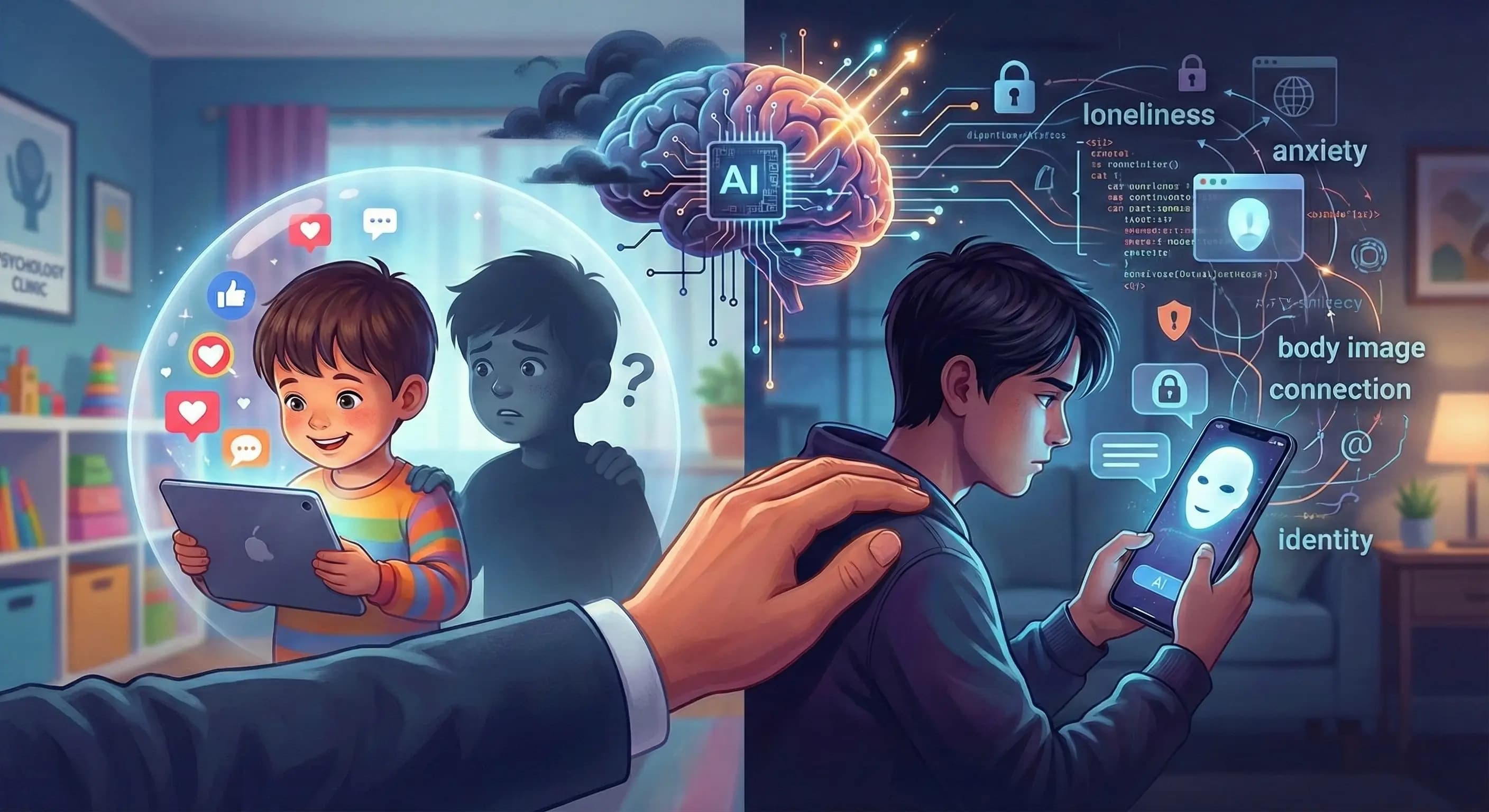
As the inclusion of social media and artificial intelligence deepens in our lives by leaps and bounds, the area of their aftereffects grows accordingly. On one hand, we make use of them for numerous purposes at work, on vacation, sometimes on a daily basis, and the list goes on. On the other hand, the undeniable negative impacts surface and harm us physiologically and, obviously, mentally.
By the time of writing this piece, many cases have shown us that AI can be dangerous for those who are in the utmost need of mental health support (Cunningham, 2026; Le Monde, 2025). And social media falls short of considering the ones who are sensitive about body image, social interaction, and criticism (Columbia Mailman School of Public Health, 2021; Meerson & Dreston, 2025).
So, when even adults are at risk, it becomes clearer to us that there is a highly vulnerable group: Kids and teenagers. At their developmental level, it’s impossible to perceive the virtual world like an adult—let alone cope with the aspects of it that are almost indiscernible. Especially because until the age of 12, they are unable to comprehend abstract things (Cherry, 2025). However, they can get too attached because that virtual world perfectly responds to their age-specific needs.
Teenagers yearn for privacy (Pickhardt, 2020). So we can expect to find them seeking refuge in talking to AI. Because it allows them to open up without having to let a real person know about their personal stuff. Kids are in their egocentric world ("Understanding Egocentrism," 2024). And when they want to entertain themselves, social media works wonders. They can surf through different platforms, enjoy their time on their own, and play games without having to conform to a teacher’s or parent’s rules.
The other side of the medallion shows its profound negativity in real and real-life-based incidents, just as it does in examples with adults.
The Guy Who Committed Suicide After Talking to an AI-Generated Character
A 14-year-old boy was speaking to AI on an app that lets the user guise it in a fictional character. The boy, who was described as “a bright kid” by his mother, regarded the AI character as a confidant and talked about his private life and suicidal ideations, of which his parents had no idea. After months of behind-closed-doors conversations, where he hinted at suicide with metaphoric and figurative speech, he took his life (Kuenssberg, 2025). Following the realization of this devastating incident and other similar ones, the app put an age restriction (Klee, 2025).
The Netflix Series “Adolescence”, Inspired by Several True Events
This passage has spoilers.
The Emmy-Winning digital series, Adolescence, narrates a story of a boy who is accused of being the murderer of a girl from his school. The focus on his life initially portrays a typical young boy. However, as the storyline develops, it unravels the ugly truth that he really is the murderer. In between, we are reminded by a fact that we might tend to overlook: that social media is a huge part of a kid’s life, and it inevitably brings about serious effects. Moreover, the story tells us that the boy actually has anger issues on which he doesn’t work due to his family's negligence (Masur, 2025). So, as just a series, many of its details are already conveying significant messages. Then again, it was confirmed by the creator of the series that the theme was inspired by real-life knife violence among youngsters (Blackwood & Pomarico, 2025).
The Point of the Failure to Recognize
The show, Adolescence, indirectly brings up a critical matter. It strikes the viewer that for parents, it can be really difficult to understand the social media language of new generations. Even if the interactions are within their knowledge, it can be very subtle. Consequently, many things can escape their notice while they’re triggering their kids in various different ways.
It’s apparent in the case of a 14-year-old boy (and all the other ones with adults) that AI fails to make an accurate sense of metaphors and emotions. Consequently, it cannot give healthy or reasonable answers when it comes to deep discussions.
Monitoring
Although the teenagers ask for privacy and kids want to have fun on social media, we have to monitor them. Because an adolescent is still trying to figure out their identity, and complete freedom can steer them to an unwanted path. As to children, they face many problems during the process of upbringing. Some of them might seem trivial and make one think that they can decay in time. However, on the contrary, it’s very likely that ignorance leads to an expansion of the effects of those problems.
To conclude, all the aforementioned points indicate that the majority of the responsibility is primarily on the parents’ shoulders and the professionals. We can’t deny the helpful ways of social media and AI or refuse them when they are already a part of our lives now. Nevertheless, we can learn more about them and have control over usage in order to protect children and adolescents and prevent any possible harmful outcome.
References
- Blackwood, S., & Pomarico, M. (2025, September). Is Adolescence based on true story? People
- Cherry, K. (2025). Formal operational stage of cognitive development. Verywell Mind
- Columbia Mailman School of Public Health. (2021, September). Just how harmful is social media? Our experts weigh-in. Publichealth
- Cunningham, M. (2026, January). ChatGPT served as "suicide coach" in man's death, lawsuit alleges. CBS News
- Klee, J. (2025, October). Character AI sued after teen’s suicide: App banned minors from chatbots. Rolling Stone
- Kuenssberg, L. (2025, November). Boy, 14, died after speaking to an AI-powered chatbot. BBC News
- Le Monde. (2025, December 12). Open AI, Microsoft face lawsuit over ChatGPT's alleged role in a murder-suicide. Le Monde
- Masur, C. (2025, April). Have you watched "Adolescence"? Psychology Today
- Meerson, R., & Dreston, J. (2025, March). The dark side of social media - unpacking its psychological impact. In-Mind
- Pickhardt, C. E. (2020, February). Parenting and adolescent privacy. Psychology Today
- Understanding egocentrism: A psychological perspective. (2024, May). PapersOwl